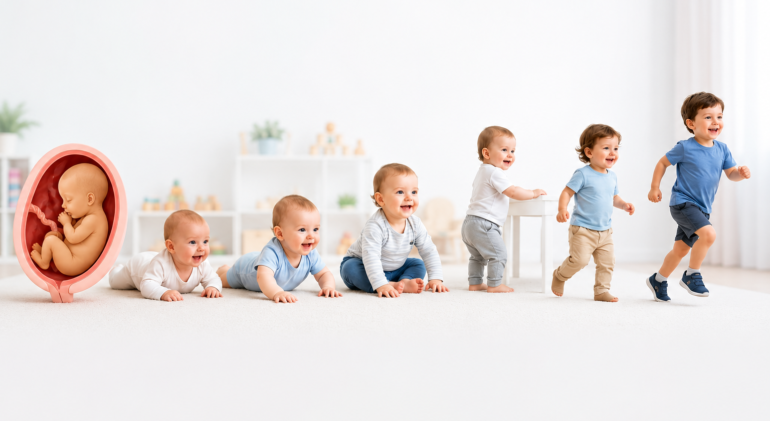
Normal motor development is the gradual process through which children learn to control their bodies, move efficiently, maintain balance, and perform everyday activities. It begins before birth and continues throughout infancy and childhood as the brain, muscles, bones, nerves, and sensory systems develop together.
Understanding normal motor development from prenatal life to childhood can help parents, caregivers, teachers, and healthcare professionals recognize important developmental milestones and identify when a child may need additional support.
Every child develops at a slightly different pace. However, there are general developmental patterns that provide useful guidelines for understanding how motor skills typically emerge.
What Is Motor Development?
Motor development refers to the progression of movement abilities as a child grows. It includes both gross motor skills and fine motor skills.
Gross motor skills involve large muscle groups and include activities such as:
- Head control
- Rolling
- Sitting
- Crawling
- Standing
- Walking
- Running
- Jumping
- Climbing
Fine motor skills involve smaller muscles, particularly those of the hands and fingers. Examples include:
- Reaching and grasping
- Holding toys
- Picking up small objects
- Drawing
- Turning pages
- Using a spoon
- Writing
Motor development is influenced by brain maturation, muscle strength, sensory experiences, genetics, nutrition, health, and opportunities for movement and play.
Prenatal Motor Development
Motor development begins before birth. During pregnancy, the baby’s nervous system, muscles, bones, and joints gradually develop and begin working together.
First Trimester
During the early stages of pregnancy, the basic structures of the nervous system, brain, muscles, and limbs begin developing. Although the movements are not yet noticeable to the mother, early movement patterns begin to emerge as the nervous system develops.
Second Trimester
As the nervous system and muscles mature, fetal movements become more coordinated. The baby may move the arms and legs, change position, stretch, and make other movements inside the uterus.
These movements are an important part of early neuromuscular development.
Third Trimester
During the later stages of pregnancy, fetal movements become increasingly organized. The developing baby practices movements such as flexing and extending the limbs, moving the head, and changing body positions.
The prenatal period provides the foundation for the motor skills that emerge after birth.
Motor Development During Infancy
The first year of life is a period of rapid motor development. Babies gradually progress from limited voluntary movement to sitting, crawling, pulling to stand, and eventually taking their first steps.
Development generally follows a predictable sequence, although the exact timing can vary from child to child.
0–3 Months: Developing Head and Body Control
During the first three months, babies gradually gain better control of their head and neck.
Common motor developments include:
- Briefly lifting the head while lying on the tummy
- Moving arms and legs actively
- Bringing hands toward the mouth
- Beginning to open and close the hands
- Turning the head toward sounds or visual stimuli
- Developing better head control when supported
Tummy time, when performed safely while the baby is awake and supervised, provides opportunities to strengthen the muscles needed for later movement.
4–6 Months: Rolling and Improved Control
Between approximately four and six months, babies typically become more active and coordinated.
They may begin to:
- Hold their head steadily
- Roll from tummy to back and back to tummy
- Reach for and hold toys
- Bring objects toward the mouth
- Push up on their arms during tummy time
- Sit with support
- Bear some weight through their legs when supported
Hand-eye coordination also becomes more developed during this stage.
7–9 Months: Sitting, Crawling, and Exploring
Around seven to nine months, many babies become increasingly independent in movement.
Typical skills may include:
- Sitting without support
- Moving from one position to another
- Reaching for objects while sitting
- Crawling or using another method of mobility
- Getting into a hands-and-knees position
- Beginning to pull up on furniture
- Transferring objects from one hand to another
Not every baby crawls in the same way. Some children crawl on hands and knees, while others use different movement patterns or move directly toward standing and walking.
10–12 Months: Standing and Early Walking
Toward the end of the first year, many babies develop stronger leg and trunk control.
They may:
- Pull themselves to stand
- Stand while holding furniture
- Move sideways while holding furniture
- Lower themselves from standing
- Stand briefly without support
- Take a few independent steps
- Pick up small objects using their fingers
Some children begin walking around their first birthday, while others take their first independent steps later. A range of individual variation can be normal.
Motor Development in Early Childhood
After infancy, motor development continues rapidly. Children refine the skills they learned during the first year and begin developing greater coordination, balance, strength, speed, and precision.
1–2 Years
Toddlers typically become increasingly mobile and independent.
Common motor skills include:
- Walking independently
- Running
- Climbing onto furniture
- Walking up stairs with support
- Kicking a ball
- Throwing objects
- Squatting and standing
- Turning pages of a book
- Building simple towers with blocks
- Beginning to use utensils
At this stage, children learn through active exploration. Safe opportunities to walk, climb, push, pull, carry, and play can support motor development.
2–3 Years: Improving Coordination
Between two and three years, children generally develop better balance and coordination.
They may begin to:
- Run with greater control
- Jump with both feet
- Walk upstairs using alternating feet with support
- Throw and kick a ball
- Pedal a tricycle
- Build taller block towers
- Draw simple lines and shapes
- Turn handles and knobs
- Use a spoon and cup more independently
Play-based activities are particularly valuable because children can practice movement without feeling like they are doing structured exercises.
3–5 Years: Developing Advanced Motor Skills
Preschool years bring significant improvements in coordination and body control.
Children may develop the ability to:
- Run, stop, and change direction
- Jump forward
- Hop on one foot
- Climb playground equipment
- Catch and throw a ball
- Balance on one foot
- Use scissors
- Draw recognizable shapes
- Copy basic letters and numbers
- Dress with increasing independence
These abilities prepare children for more complex physical activities, sports, school tasks, and self-care skills.
Motor Development During School-Age Childhood
From approximately five years onward, children continue refining their gross and fine motor abilities.
They may develop improved skills in:
- Running and jumping
- Balance and coordination
- Cycling
- Swimming
- Sports activities
- Handwriting
- Drawing and crafts
- Using classroom tools
- Dressing and personal care
Motor development during school years is not simply about learning new movements. Children also improve strength, endurance, timing, coordination, reaction speed, and motor planning.
Factors That Influence Motor Development
Several factors can influence how a child develops motor skills.
1. Brain and Nervous System Development
The brain and nervous system coordinate movement. Healthy neurological development is essential for acquiring new motor skills.
2. Muscle Strength and Tone
Adequate muscle strength and appropriate muscle tone help children maintain posture and perform movements efficiently.
3. Sensory Development
Vision, balance, touch, and body awareness provide important information that helps children understand how their bodies move through space.
4. Opportunities for Movement
Children need regular opportunities to play, explore, reach, crawl, walk, climb, and practice different movements.
5. Health and Nutrition
Overall health and adequate nutrition support healthy growth and physical development.
6. Environment
A safe and stimulating environment can encourage children to explore movement and develop independence.
When Should Parents Be Concerned?
Developmental milestones are useful guidelines rather than strict deadlines. However, parents should discuss concerns with a pediatrician or qualified pediatric physiotherapist if a child shows significant difficulty acquiring expected skills, loses previously acquired skills, or consistently struggles with movement, balance, coordination, or posture.
Possible signs that may deserve professional assessment include:
- Significant difficulty controlling the head
- Difficulty sitting independently when expected
- Limited use of one side of the body
- Persistent difficulty with age-appropriate movement
- Frequent falls beyond what is expected for the child’s developmental stage
- Difficulty walking or running compared with peers
- Loss of previously acquired motor skills
- Unusual stiffness or floppiness
- Difficulty using the hands for age-appropriate tasks
Early assessment does not automatically mean that a child has a developmental disorder. It simply helps determine whether additional evaluation, guidance, or therapy could be beneficial.
How Can Parents Support Normal Motor Development?
Parents can encourage motor development through simple everyday activities.
Encourage Floor Play
Give babies and young children safe opportunities to move freely on the floor.
Provide Age-Appropriate Toys
Toys that encourage reaching, grasping, stacking, pushing, pulling, and building can support motor skills.
Encourage Outdoor Play
Walking, running, climbing, jumping, and ball games help develop gross motor abilities.
Practice Fine Motor Activities
Drawing, coloring, blocks, puzzles, play dough, and age-appropriate crafts can strengthen hand coordination.
Avoid Excessive Sedentary Time
Children benefit from regular opportunities to move and explore rather than spending long periods in restrictive positions.
Follow the Child’s Pace
Children develop at different rates. Encourage practice without comparing one child’s development directly with another.
Frequently Asked Questions About Normal Motor Development
What is normal motor development?
Normal motor development is the progressive acquisition of movement skills, including head control, rolling, sitting, crawling, standing, walking, running, and fine motor abilities.
When does motor development begin?
Motor development begins during the prenatal period, when the nervous system, muscles, and body structures start developing and coordinated fetal movements emerge.
What are gross motor skills?
Gross motor skills involve large muscle groups and include sitting, standing, walking, running, jumping, climbing, and balancing.
What are fine motor skills?
Fine motor skills involve smaller muscles, particularly the hands and fingers. Examples include grasping, drawing, writing, using utensils, and manipulating small objects.
Do all children reach milestones at the same age?
No. There is normal variation in the timing of developmental milestones. However, significant delays, loss of skills, or persistent movement difficulties should be discussed with a healthcare professional.
Conclusion
Normal motor development from prenatal life through infancy and childhood is a continuous process involving the brain, nervous system, muscles, senses, and environment. From the first fetal movements to walking, running, writing, and participating in sports, children gradually build increasingly complex movement abilities.
Understanding developmental milestones can help parents recognize progress while also identifying situations where professional guidance may be useful. Providing children with safe opportunities for movement, play, exploration, and age-appropriate activities can create a supportive environment for healthy motor development.
If you have concerns about your child’s movement, balance, coordination, posture, or developmental milestones, consulting a qualified pediatric healthcare professional or pediatric physiotherapist can help provide appropriate assessment and guidance.