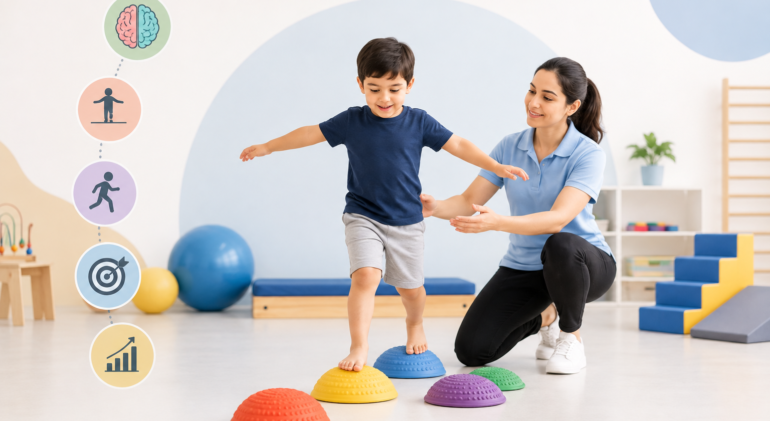
Motor learning is the process through which a person develops or improves movement skills through practice, experience, feedback, and adaptation. In children, motor learning plays an important role in developing skills such as sitting, walking, running, jumping, reaching, writing, throwing, and participating in sports.
For pediatric physiotherapists, understanding the motor learning process, theories, and techniques helps create effective therapy programs that encourage children to develop functional movement skills and become more independent.
Motor learning is not simply about repeating an exercise. It involves the brain and body working together to understand a movement, practice it, receive information about performance, and gradually improve the ability to perform the skill.
What Is Motor Learning?
Motor learning can be described as a relatively lasting improvement in the ability to perform a motor skill as a result of practice and experience.
For example, a child learning to catch a ball may initially struggle with timing, hand position, and visual tracking. With repeated practice and appropriate guidance, the child gradually learns how to position the hands, judge the ball’s movement, and coordinate the arms with the eyes.
Motor learning can help children improve:
- Balance
- Coordination
- Postural control
- Walking
- Running
- Jumping
- Reaching and grasping
- Hand function
- Motor planning
- Sports skills
- Functional independence
Stages of the Motor Learning Process
Motor learning is commonly explained through different stages. Understanding these stages helps therapists select appropriate activities and feedback.
1. Cognitive Stage
During the cognitive stage, the child is learning what to do and how to perform the movement.
The child may need demonstrations, simple instructions, visual cues, or physical guidance.
For example, when learning to kick a ball, the therapist may demonstrate:
- Stand near the ball.
- Position the supporting foot.
- Move the kicking leg backward.
- Swing the leg forward.
- Contact the ball.
At this stage, performance may be inconsistent because the child is still trying to understand the movement.
Therapy Approach
During the cognitive stage, therapists can use:
- Simple instructions
- Demonstrations
- Visual cues
- Short practice sessions
- Appropriate physical assistance
- Encouragement
- Frequent feedback
The goal is to help the child understand the movement without overwhelming them with too much information.
2. Associative Stage
During the associative stage, the child has a better understanding of the movement and begins refining the skill.
The movement becomes more consistent, and the child starts recognizing mistakes and making adjustments.
For example, a child learning to walk may gradually improve:
- Step length
- Balance
- Weight shifting
- Foot placement
- Coordination
- Walking speed
At this stage, therapists can gradually reduce assistance and encourage the child to solve movement problems independently.
Therapy Approach
Useful techniques may include:
- Repetition
- Practice in different environments
- Reduced physical assistance
- Specific feedback
- Problem-solving activities
- Task variation
The child should be encouraged to actively participate rather than simply follow therapist instructions.
3. Autonomous Stage
The autonomous stage occurs when a motor skill becomes relatively automatic.
The child can perform the movement with less conscious attention.
For example, once walking becomes well established, a child can often walk while talking, looking at objects, or carrying something.
At this stage, therapy may focus on improving:
- Speed
- Accuracy
- Efficiency
- Endurance
- Adaptability
- Complex movement combinations
Children can also practice using their skills in real-life situations.
Important Motor Learning Theories
Several theories have been developed to explain how people learn and control movement.
Schema Theory
Schema theory suggests that the brain develops generalized movement patterns based on previous experiences.
Instead of storing every movement as a completely separate skill, the brain can use previous experiences to adapt movements to new situations.
For example, after learning to throw a large ball, a child may be able to adjust the movement when throwing a smaller ball.
In pediatric therapy, this supports the use of varied practice rather than repeating exactly the same movement every time.
Dynamic Systems Theory
Dynamic systems theory views movement as the result of interaction between multiple factors.
These factors may include:
- The child
- The task
- The environment
For example, a child’s ability to climb stairs can be influenced by their strength, balance, motivation, the height of the steps, footwear, and whether they are holding a railing.
This theory emphasizes that motor development is not controlled by one factor alone.
Clinical Application
Therapists can modify:
- The task difficulty
- The environment
- The equipment
- The child’s position
- The amount of assistance
This allows children to practice movements at an appropriate challenge level.
Ecological Approach to Motor Learning
The ecological approach emphasizes the relationship between the child and their environment.
Children learn movement skills by exploring what they can do within their surroundings.
For example, a child may learn to climb by exploring playground equipment rather than practicing climbing only as a repetitive exercise.
This approach encourages therapists to create environments where children can actively explore and discover movement solutions.
Motor Learning Techniques in Pediatric Physiotherapy
1. Repetition
Repetition is an important component of motor learning.
Children need sufficient practice opportunities to develop movement skills. However, repetition should be meaningful and engaging rather than monotonous.
For example, instead of repeatedly asking a child to step forward, a therapist could create a game where the child steps onto colored targets.
2. Task-Specific Training
Task-specific training involves practicing the actual activity the child wants or needs to perform.
For example:
- Practicing standing to improve standing
- Practicing walking to improve walking
- Practicing reaching to improve reaching
- Practicing stair climbing to improve stair mobility
Functional practice allows children to connect therapy activities with real-life goals.
3. Feedback
Feedback provides information about movement performance.
Two common forms are:
Knowledge of Results
This tells the child whether the goal was achieved.
Example:
“You reached the target.”
Knowledge of Performance
This provides information about how the movement was performed.
Example:
“Try keeping your supporting foot closer to the ball.”
Feedback should be appropriate for the child’s developmental level and should not become so frequent that the child becomes dependent on external guidance.
4. Demonstration and Modeling
Children often learn effectively by watching others.
A therapist can demonstrate a movement before asking the child to perform it.
Visual demonstrations may be particularly helpful for children who have difficulty understanding lengthy verbal instructions.
Parents, siblings, teachers, and peers can also provide useful movement models.
5. Verbal and Visual Cues
Simple cues can help children understand what to do.
Examples include:
- “Look forward.”
- “Reach up.”
- “Step over.”
- “Hands on the floor.”
- “Stand tall.”
Visual targets such as colored markers, footprints, hoops, or objects can make instructions easier to understand.
6. Practice Variability
Practice variability means changing aspects of a task during learning.
For example, a child practicing throwing could throw:
- Different sizes of balls
- Different distances
- Toward different targets
- From different positions
This can help children learn to adapt movement to changing situations.
7. Blocked and Random Practice
Blocked practice involves repeating the same task several times before moving to another task.
For example:
Throw → throw → throw → throw.
Random practice involves changing tasks more frequently.
For example:
Throw → kick → catch → throw → jump.
Blocked practice can be useful when initially learning a skill, while more variable practice can challenge the child to adapt and apply skills in different situations.
8. Part Practice and Whole Practice
Some complex skills can be divided into smaller components.
For example, learning to ride a bicycle may involve practicing:
- Balance
- Pedaling
- Steering
- Starting and stopping
These components can then be combined into the complete skill.
However, whenever possible, children should also have opportunities to practice the complete functional task.
9. Guided Discovery
Guided discovery allows children to find movement solutions rather than always being told exactly what to do.
For example, instead of saying exactly where to place their feet, a therapist might ask:
“Can you find a way to step over the obstacle without touching it?”
This encourages problem-solving, exploration, and active participation.
10. Motivation and Play
Play is one of the most effective ways to encourage motor learning in children.
Games can transform therapeutic activities into meaningful experiences.
For example:
- Throwing games for upper-limb coordination
- Obstacle courses for balance
- Dancing for rhythm and movement
- Balloon games for reaching
- Treasure hunts for walking and exploration
- Jumping games for lower-limb coordination
When children are interested in an activity, they are often more willing to practice and repeat movements.
Role of Parents in Motor Learning
Parents can support motor learning by providing safe opportunities for movement at home.
Simple activities may include:
- Playing catch
- Building with blocks
- Dancing
- Drawing
- Playing on age-appropriate playground equipment
- Practicing stairs when appropriate
- Walking outdoors
- Playing movement-based games
Parents should focus on encouragement and participation rather than correcting every movement.
Motor Learning and Pediatric Physiotherapy
Pediatric physiotherapists use principles of motor learning to help children improve functional movement.
Therapy may be appropriate for children experiencing difficulties with:
- Delayed motor development
- Balance
- Coordination
- Walking
- Postural control
- Muscle strength
- Motor planning
- Sports skills
- Functional mobility
A pediatric physiotherapist can assess the child’s individual abilities and create activities that provide an appropriate level of challenge.
The aim is to help the child become an active participant in learning movement rather than simply receiving physical assistance.
Frequently Asked Questions About Motor Learning
What is the motor learning process?
Motor learning is the process of improving movement skills through practice, experience, feedback, and adaptation.
What are the three stages of motor learning?
The commonly described stages are the cognitive stage, associative stage, and autonomous stage.
Why is repetition important in motor learning?
Repetition provides opportunities to practice and refine movement skills. Meaningful and varied repetition can help children apply skills in different situations.
What is task-specific training?
Task-specific training involves practicing the actual movement or activity that a child needs to improve, such as walking, reaching, standing, or climbing stairs.
Can play improve motor learning?
Yes. Play provides meaningful opportunities for children to practice movement, solve problems, interact with their environment, and develop motor skills.
Conclusion
The motor learning process is an important part of pediatric physiotherapy and child development. Through practice, feedback, exploration, motivation, and meaningful activities, children gradually develop more efficient and adaptable movement skills.
Motor learning theories such as schema theory, dynamic systems theory, and ecological approaches provide useful frameworks for understanding how children acquire movement abilities. Techniques such as task-specific training, repetition, feedback, demonstration, variable practice, guided discovery, and play can be incorporated into individualized therapy programs.
The ultimate goal of motor learning is not simply to perform an exercise correctly. It is to help children use their movement skills confidently and independently in everyday life, play, school, and physical activities.