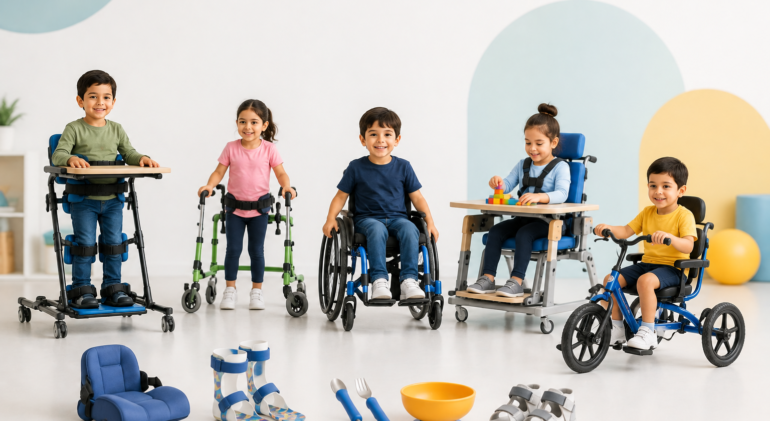
Adaptive equipment for physically challenged children can play an important role in improving mobility, participation, safety, and independence. Children with physical disabilities, developmental conditions, neurological difficulties, or movement limitations may require additional support to participate in everyday activities.
Adaptive equipment is designed or modified to help children perform activities that may otherwise be difficult. Depending on the child’s individual needs, equipment may support sitting, standing, walking, communication, feeding, bathing, playing, learning, or participating in school and community activities.
The right equipment should always be selected according to the child’s abilities, developmental stage, goals, environment, and safety requirements. A pediatric physiotherapist or other qualified rehabilitation professional can help assess these needs and recommend appropriate solutions.
What Is Adaptive Equipment?
Adaptive equipment refers to specialized devices or modifications that help a child perform functional activities more safely and independently.
Unlike standard equipment, adaptive equipment may be customized to accommodate differences in:
- Strength
- Balance
- Muscle tone
- Coordination
- Joint movement
- Postural control
- Mobility
- Hand function
- Sensory needs
The main goal is not simply to provide physical support. Good adaptive equipment should help a child participate in meaningful everyday activities and develop greater independence.
Why Is Adaptive Equipment Important for Children?
Children learn and develop through participation. When physical limitations make it difficult to sit, stand, move, play, or interact with their surroundings, adaptive equipment can help reduce these barriers.
1. Promotes Independence
Adaptive equipment can allow children to participate in activities with less assistance from parents or caregivers.
For example, an appropriately designed seating system may help a child maintain a stable position while eating, playing, or working at a table.
2. Supports Functional Mobility
Mobility equipment can help children move around their home, school, therapy center, playground, or community.
Depending on their abilities, children may benefit from equipment such as walkers, standing devices, or wheelchairs.
3. Improves Participation
Equipment can help children take part in activities alongside their family and peers.
Participation may include:
- Playing
- Eating
- Going to school
- Moving around the classroom
- Participating in sports or recreation
- Socializing
- Exploring the environment
4. Supports Positioning
Appropriate positioning can help children maintain functional and comfortable body alignment during activities.
Good positioning may support participation in feeding, learning, play, and communication.
Types of Adaptive Equipment for Children
There are many types of adaptive equipment, and the appropriate option varies significantly between children.
1. Adaptive Seating Systems
Adaptive seating systems are designed to provide appropriate support for children who have difficulty maintaining a stable sitting position.
They may include:
- Supportive chairs
- Specialized seating systems
- Positioning cushions
- Lateral supports
- Head supports
- Adjustable foot supports
Adaptive seating can help a child participate in activities such as eating, studying, playing, and communicating.
2. Standing Frames and Standing Equipment
Some children may benefit from equipment that supports them in an upright standing position.
Standing equipment may provide support through the trunk, pelvis, and lower limbs.
Potential benefits can include opportunities to:
- Practice upright positioning
- Participate in activities at standing height
- Interact with peers
- Reach for objects
- Participate in play
The appropriate use of standing equipment should be determined according to the child’s individual needs and professional assessment.
3. Walkers and Gait Trainers
Children who have difficulty walking independently may use mobility devices such as walkers or gait trainers.
These devices can provide varying levels of support while allowing children to practice walking.
Depending on the child’s needs, a mobility device may support:
- Trunk control
- Balance
- Weight bearing
- Lower-limb movement
- Forward movement
The objective is to provide the appropriate amount of assistance while encouraging active participation.
4. Pediatric Wheelchairs and Mobility Devices
Some children may require wheelchairs for independent mobility.
A properly fitted pediatric wheelchair can help children move around more efficiently and participate in school, family activities, recreation, and community life.
Wheelchairs may be:
- Manual
- Powered
- Specialized for different positioning needs
The child’s size, posture, strength, mobility goals, and environment should all be considered when selecting a wheelchair.
5. Orthoses and Bracing
Orthoses are devices designed to support or influence the position and movement of a body part.
Examples include:
- Ankle-foot orthoses
- Foot orthoses
- Knee supports
- Wrist-hand orthoses
Orthoses may be recommended for specific functional or positioning goals. They should be properly fitted and regularly reviewed as the child grows.
6. Adaptive Bicycles and Tricycles
Adaptive bicycles and tricycles can provide opportunities for children with movement difficulties to participate in recreational activities.
They may include features such as:
- Additional trunk support
- Specialized seating
- Foot supports
- Stability features
- Modified pedals
Cycling can be a motivating way to encourage movement, outdoor participation, and recreation when the equipment is appropriate for the child.
7. Adaptive Feeding Equipment
Some children may experience difficulty using standard spoons, cups, plates, or other feeding tools.
Adaptive feeding equipment can include:
- Modified handles
- Specialized spoons
- Non-slip plates
- Angled utensils
- Cups designed for easier handling
The purpose is to make feeding activities more manageable while encouraging as much independence as possible.
Children with significant feeding or swallowing difficulties should receive appropriate professional assessment rather than relying solely on adaptive equipment.
8. Adaptive Bathing and Toileting Equipment
Personal care can be challenging for children with limited mobility or postural control.
Equipment may include:
- Shower chairs
- Bath supports
- Toilet frames
- Grab bars
- Specialized transfer equipment
These devices can help improve safety and make daily routines easier for children and caregivers.
9. Adaptive Writing and Learning Equipment
Children with limited hand strength or coordination may find classroom tasks difficult.
Adaptive learning equipment may include:
- Pencil grips
- Modified writing tools
- Slanted writing surfaces
- Specialized scissors
- Book supports
- Adjustable desks
These tools can help children participate in classroom activities while reducing unnecessary physical barriers.
10. Adaptive Play Equipment
Play is essential for childhood development. Children with physical disabilities should have opportunities to explore, play, and interact with other children.
Adaptive play equipment can include:
- Modified toys
- Switch-accessible toys
- Supportive seating
- Adapted bicycles
- Accessible playground equipment
- Large-handled toys
- Positioning supports
The aim is to make play more accessible without removing the child’s opportunity to actively explore and make choices.
Benefits of Adaptive Equipment
When appropriately selected and used, adaptive equipment can support several areas of a child’s life.
Improved Mobility
Mobility devices can help children move around their environments and access activities.
Greater Independence
Adaptive tools can allow children to perform parts of daily activities with less assistance.
Better Participation
Children may be able to participate more fully in school, play, family activities, and community experiences.
Increased Confidence
Being able to accomplish tasks independently can support confidence and motivation.
Reduced Physical Barriers
Adaptive equipment can modify the environment or activity so that the child can participate more effectively.
Choosing the Right Adaptive Equipment
Selecting adaptive equipment should not be based only on the child’s diagnosis.
Two children with the same diagnosis may have completely different abilities and equipment needs.
Important considerations include:
- Age and developmental level
- Height and body size
- Strength
- Muscle tone
- Balance
- Postural control
- Range of movement
- Hand function
- Mobility
- Communication abilities
- Home environment
- School environment
- Family priorities
- Child’s personal goals
The equipment should be practical, comfortable, safe, and suitable for the activities the child actually wants and needs to perform.
The Role of Pediatric Physiotherapy
A pediatric physiotherapist can contribute significantly to the assessment and selection of adaptive equipment.
A physiotherapist may evaluate:
- Posture
- Balance
- Strength
- Muscle tone
- Mobility
- Walking pattern
- Transfers
- Functional movement
- Positioning
- Participation in daily activities
The therapist can then work with the family and other professionals to determine whether adaptive equipment could support the child’s goals.
Equipment may also need to be adjusted over time because children grow and their abilities can change.
Importance of Proper Fitting and Follow-Up
Adaptive equipment should be appropriately fitted to the individual child.
Poorly fitted equipment may be uncomfortable or may not provide the intended support. Children’s bodies also change quickly as they grow, so equipment should be reviewed periodically.
Parents and caregivers should follow the instructions provided by the relevant healthcare or rehabilitation professionals and report concerns such as discomfort, skin irritation, difficulty using the equipment, or changes in the child’s movement.
How Parents Can Encourage Independence
Adaptive equipment works best when it supports active participation rather than unnecessarily replacing the child’s own abilities.
Parents can encourage independence by:
- Allowing the child to try tasks independently
- Providing appropriate assistance when needed
- Choosing activities that match the child’s abilities
- Encouraging participation in family routines
- Offering accessible play opportunities
- Celebrating effort and progress
- Reviewing equipment needs as the child develops
The goal should always be to help the child participate as independently as possible.
Frequently Asked Questions About Adaptive Equipment
What is adaptive equipment for children?
Adaptive equipment consists of specialized or modified devices that help children with physical or functional limitations participate in everyday activities more safely and independently.
Who may benefit from adaptive equipment?
Children with mobility, coordination, strength, balance, postural, or other functional difficulties may benefit from adaptive equipment when it is appropriate for their individual needs.
Can adaptive equipment help a child walk?
Mobility devices such as walkers and gait trainers can provide appropriate support for some children while they practice or participate in walking.
Does every child with a physical disability need adaptive equipment?
No. Equipment needs vary significantly between children. Some children may need little or no adaptive equipment, while others may benefit from several types of support.
How often should adaptive equipment be reviewed?
Equipment should be reviewed as the child’s size, abilities, goals, and environment change. Children may require adjustments or replacement equipment as they grow.
Conclusion
Adaptive equipment for physically challenged children can help reduce barriers to mobility, self-care, learning, play, and participation. From adaptive seating and standing systems to walkers, wheelchairs, orthoses, feeding tools, and adapted play equipment, these solutions can be tailored to a child’s individual needs.
The most important consideration is not simply selecting equipment but choosing the right equipment for the child’s functional goals, abilities, environment, and development.
With appropriate assessment, professional guidance, proper fitting, and regular follow-up, adaptive equipment can support children in becoming more independent and participating more fully in everyday life. Pediatric physiotherapists and other rehabilitation professionals can work with families to identify practical solutions that support the child’s development and quality of life.