
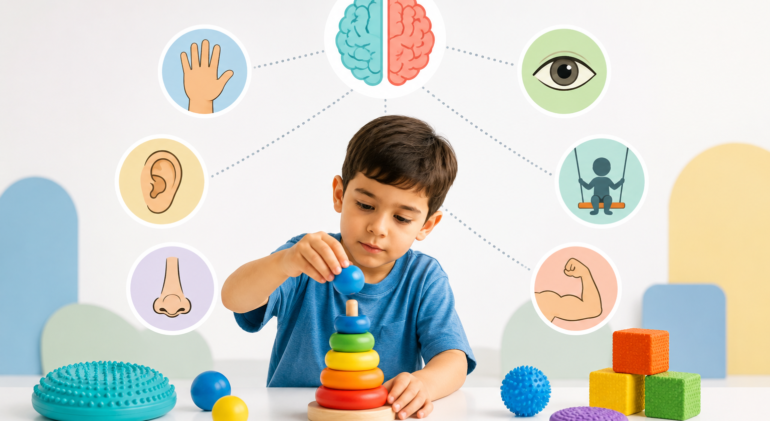
Disorders of perception and sensory integration can affect how children receive, organize, interpret, and respond to information from their surroundings and their own bodies. Sensory information comes through different systems, including touch, movement, vision, hearing, taste, smell, and body awareness.
For most children, the brain automatically processes these sensations and helps the child respond appropriately. However, some children may find certain sensations overwhelming, confusing, or difficult to interpret. This can affect their movement, behavior, attention, learning, communication, play, and everyday activities.
Understanding sensory integration and perception disorders in children can help parents and caregivers recognize challenges and seek appropriate professional guidance when needed.
What Is Sensory Integration?
Sensory integration refers to the brain’s ability to receive sensory information, organize it, and use it to produce an appropriate response.
Every moment, the brain receives information from the environment and the body. For example, when a child walks across a playground, the brain processes information about:
- The surface under the feet
- Body position
- Movement and balance
- Visual surroundings
- Sounds
- Touch
- Muscle and joint movement
The brain combines this information to help the child maintain balance, coordinate movements, avoid obstacles, and participate in play.
When sensory information is difficult to process or organize, a child may respond differently from what is expected for the situation.
What Are Disorders of Perception?
Perception is the process through which the brain interprets sensory information. A child may receive sensory information normally but have difficulty understanding or organizing what that information means.
Perceptual difficulties can affect areas such as:
- Visual perception
- Auditory perception
- Spatial awareness
- Body awareness
- Position and movement awareness
- Tactile perception
- Motor planning
These difficulties can sometimes interfere with activities such as dressing, handwriting, playing games, navigating spaces, or following instructions.
Understanding Sensory Processing
Sensory processing involves several systems that work together to help children understand their bodies and surroundings.
1. Tactile System
The tactile system processes information received through the skin.
It helps children understand sensations such as:
- Touch
- Pressure
- Temperature
- Texture
- Pain
A child with tactile processing difficulties may dislike certain clothing materials, avoid messy play, or become uncomfortable with unexpected touch.
Other children may actively seek additional touch or physical sensations.
2. Vestibular System
The vestibular system is associated with balance and the perception of head and body movement.
It contributes to:
- Balance
- Postural control
- Spatial orientation
- Eye and head coordination
- Movement awareness
Children with vestibular processing difficulties may appear uncomfortable with activities such as swinging, climbing, spinning, or changes in body position. Others may constantly seek movement.
3. Proprioceptive System
Proprioception provides information about the position and movement of the body through receptors in muscles and joints.
It helps children understand where their arms, legs, and other body parts are without constantly looking at them.
Proprioceptive processing contributes to:
- Body awareness
- Coordination
- Posture
- Force control
- Motor planning
A child may have difficulty judging how much force to use when pushing, pulling, throwing, or handling objects.
4. Visual System
Vision provides information about shapes, colors, movement, distance, and spatial relationships.
Visual perceptual difficulties may affect a child’s ability to:
- Find objects in a busy environment
- Recognize shapes
- Copy patterns
- Judge distances
- Understand spatial relationships
- Organize visual information
These challenges may sometimes affect classroom activities, drawing, puzzles, handwriting, or sports.
5. Auditory System
The auditory system processes sounds and helps children understand speech and environmental noises.
Some children may be particularly sensitive to loud or unexpected sounds, while others may appear less responsive to certain sounds.
Auditory processing difficulties can sometimes affect a child’s ability to follow verbal instructions or concentrate in noisy environments.
6. Smell and Taste
Smell and taste contribute to how children experience food and their environment.
Some children may be highly sensitive to particular smells, flavors, or food textures. This may contribute to restricted food preferences or difficulties participating in mealtimes.
Common Signs of Sensory Integration Difficulties
Sensory processing differences can appear differently from one child to another.
Some common signs may include:
- Strong reactions to certain sounds
- Discomfort with particular clothing textures
- Avoiding messy activities
- Seeking constant movement
- Difficulty sitting still
- Frequent crashing, jumping, or pushing into objects
- Difficulty with balance
- Poor body awareness
- Difficulty learning new motor skills
- Becoming overwhelmed in crowded or noisy environments
- Difficulty transitioning between activities
- Avoiding certain playground equipment
- Difficulty with fine motor tasks
- Problems coordinating movements
- Difficulty organizing actions or following multi-step activities
These signs do not automatically indicate a sensory disorder. Children can occasionally show sensory preferences or sensitivities without having a clinically significant condition.
Sensory Seeking and Sensory Avoiding
Children can respond to sensory information in different ways.
Sensory Seeking
A sensory-seeking child may actively look for additional sensory experiences.
Examples may include:
- Constantly moving
- Jumping frequently
- Touching objects
- Spinning
- Seeking strong movement
- Playing with objects repeatedly
- Enjoying pushing or pulling activities
Sensory Avoiding
A sensory-avoiding child may become uncomfortable or overwhelmed by particular sensory experiences.
They may:
- Avoid loud environments
- Dislike certain textures
- Avoid swings or climbing equipment
- Become uncomfortable with physical contact
- Avoid messy activities
- Cover their ears around loud sounds
Some children may also have difficulty noticing certain sensory information and may require stronger or more noticeable input before responding.
How Sensory Integration Difficulties Can Affect Daily Life
Sensory processing challenges can influence many areas of childhood.
Learning
A child who becomes easily overwhelmed by classroom sounds or visual distractions may find it difficult to concentrate.
Motor Development
Sensory information is essential for balance, coordination, posture, and motor planning. Processing difficulties may make some physical activities more challenging.
Social Participation
Children who find certain environments overwhelming may avoid group activities, playgrounds, parties, or other social situations.
Self-Care
Sensory sensitivities can sometimes affect activities such as:
- Dressing
- Bathing
- Brushing teeth
- Eating
- Hair care
Play
Sensory challenges may influence how children interact with toys, playground equipment, and other children.
Sensory Integration and Pediatric Physiotherapy
A pediatric physiotherapist can help assess how sensory and motor factors may be affecting a child’s functional abilities.
Depending on the child’s needs, therapy may focus on:
- Balance
- Postural control
- Gross motor skills
- Coordination
- Body awareness
- Motor planning
- Functional mobility
- Strength and movement
- Participation in age-appropriate activities
Sensory-based activities may be incorporated into an individualized therapy program when clinically appropriate.
The goal is not simply to expose a child to more sensory stimulation. Instead, therapy should focus on helping the child participate more effectively and comfortably in meaningful everyday activities.
Sensory Integration Activities for Children
Activities should always be selected according to the child’s developmental level, preferences, and individual needs.
Examples of movement-based activities may include:
Obstacle Courses
Simple obstacle courses can combine crawling, stepping, balancing, reaching, and climbing.
Ball Games
Throwing, catching, kicking, and rolling balls can support coordination and body awareness.
Balance Activities
Walking along a line or using age-appropriate balance equipment can provide opportunities to practice postural control.
Push-and-Pull Activities
Age-appropriate pushing and pulling games can provide opportunities for children to use their muscles and develop body awareness.
Movement Games
Animal walks, dancing, jumping games, and action songs can encourage movement and coordination.
Fine Motor Play
Blocks, puzzles, drawing, crafts, and age-appropriate manipulation activities can support hand coordination and visual-motor skills.
Activities should be enjoyable and should not be forced when a child is clearly distressed.
How Parents Can Support Children With Sensory Challenges
Parents can create a supportive environment by observing what situations are difficult for their child.
Helpful strategies may include:
Understand the Child’s Sensory Preferences
Notice which sounds, textures, movements, or environments appear comfortable or uncomfortable.
Provide Predictable Routines
Consistent routines can help children know what to expect throughout the day.
Prepare for New Environments
Before visiting a crowded or unfamiliar location, explain what the child can expect.
Offer Appropriate Movement Opportunities
Regular opportunities for age-appropriate physical activity can support participation and motor development.
Avoid Unnecessary Overstimulation
Busy environments, loud sounds, and excessive visual stimulation may be challenging for some children.
Encourage, Don’t Force
Children should be supported gradually rather than forced into sensory experiences that cause significant distress.
When Should Parents Seek Professional Help?
Parents may consider seeking professional assessment when sensory or perceptual difficulties consistently interfere with everyday activities.
Professional guidance may be useful if a child has persistent difficulties with:
- Movement
- Balance
- Coordination
- Motor planning
- Self-care
- Feeding
- Learning
- Play
- Participation in school or social activities
- Tolerance of everyday sensory experiences
A pediatrician can help determine whether further evaluation is appropriate. Depending on the child’s difficulties, assessment may involve professionals such as pediatric physiotherapists, occupational therapists, psychologists, speech-language professionals, or other specialists.
Frequently Asked Questions About Sensory Integration
What is sensory integration?
Sensory integration is the brain’s process of receiving, organizing, and using sensory information to create appropriate responses.
What are sensory processing difficulties?
Sensory processing difficulties occur when a child has challenges responding to or organizing sensory information in a way that affects everyday functioning.
Can sensory integration difficulties affect motor skills?
Yes. Sensory information contributes to balance, posture, body awareness, coordination, and motor planning, so difficulties with processing sensory information may affect movement and participation.
Are sensory sensitivities the same for every child?
No. Children can respond to sensory information in very different ways. Some may seek additional sensory input, while others may avoid particular sensations.
Can physiotherapy help children with sensory and motor difficulties?
Pediatric physiotherapy can support functional movement, balance, coordination, posture, and motor development. A qualified professional can determine whether physiotherapy is appropriate based on the child’s individual needs.
Conclusion
Disorders of perception and sensory integration can influence how children understand and respond to information from their bodies and surroundings. Sensory processing plays an important role in movement, balance, coordination, learning, play, self-care, and participation in everyday activities.
Recognizing a child’s individual sensory and perceptual needs can help parents and professionals create supportive environments and appropriate activities. When sensory or perceptual difficulties significantly affect daily life, professional assessment can help identify the child’s strengths and areas requiring support.
With individualized guidance and appropriate intervention, children can be supported in developing functional skills and participating more confidently in everyday activities, school, play, and social experiences.