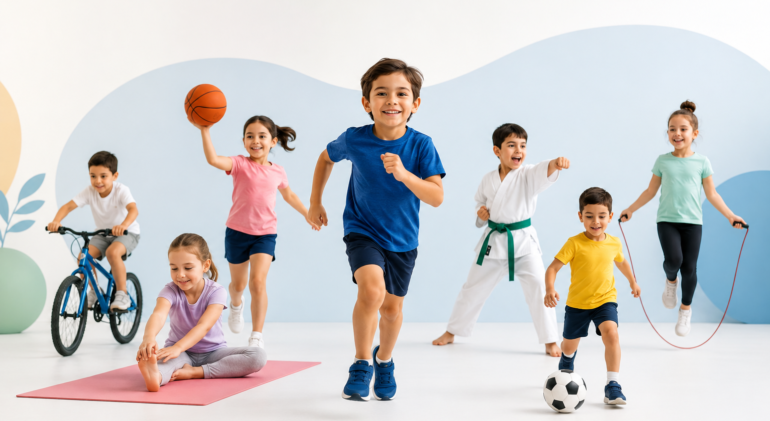
Sports and fitness in pediatrics play an important role in a child’s physical, mental, social, and emotional development. Regular physical activity helps children develop stronger muscles and bones, improve coordination and balance, maintain healthy cardiovascular function, and build confidence.
Children naturally learn through movement. Running, jumping, climbing, swimming, cycling, playing games, and participating in sports provide opportunities to develop essential motor skills while having fun. Encouraging children to stay active from an early age can also help establish healthy habits that continue into adolescence and adulthood.
However, pediatric fitness should always be age-appropriate, enjoyable, safe, and focused on overall development rather than performance alone.
What Is Pediatric Fitness?
Pediatric fitness refers to physical activity and exercise designed according to a child’s age, developmental stage, physical abilities, and individual needs.
Unlike adult fitness programs, children’s fitness should focus primarily on:
- Developing fundamental movement skills
- Improving coordination and balance
- Building strength through age-appropriate activities
- Developing flexibility and mobility
- Improving cardiovascular endurance
- Encouraging confidence and independence
- Making physical activity enjoyable
The goal is not simply to make children stronger or faster. It is to help them develop the physical skills they need to participate confidently in everyday activities, school, recreation, and sports.
Why Are Sports Important for Children?
Sports provide children with opportunities to practice different movement patterns in an enjoyable environment. Regular participation can support several aspects of development.
1. Improves Gross Motor Skills
Sports such as football, basketball, swimming, athletics, and cycling involve movements such as running, jumping, kicking, throwing, catching, and changing direction.
These activities help children improve gross motor skills, which are essential for everyday movement.
2. Develops Balance and Coordination
Many sports require children to control their bodies while moving quickly or responding to changing situations.
Activities involving catching, kicking, balancing, or changing direction can help develop:
- Hand-eye coordination
- Foot-eye coordination
- Dynamic balance
- Body awareness
- Motor planning
- Reaction skills
3. Supports Bone and Muscle Development
Age-appropriate physical activity provides opportunities for children to use their muscles and move their bodies against gravity.
Activities such as running, jumping, climbing, and playground games can contribute to healthy physical development.
4. Supports Cardiovascular Fitness
Active games and sports can improve endurance and help children participate in physical activities for longer periods.
Children can develop cardiovascular fitness through enjoyable activities such as running games, swimming, cycling, dancing, and active playground play.
Mental and Social Benefits of Sports
The benefits of pediatric sports extend beyond physical development.
Participation in sports can provide opportunities for children to:
- Build self-confidence
- Develop teamwork skills
- Learn communication
- Practice problem-solving
- Develop discipline
- Handle winning and losing
- Build friendships
- Improve independence
Team sports can particularly help children learn how to cooperate with others and understand the importance of communication.
Physical activity can also provide children with an opportunity to take a break from sedentary activities and engage in active play.
Fitness Activities for Different Age Groups
Children have different physical and developmental needs at different ages. Therefore, activities should be selected according to the child’s developmental stage.
Infants and Toddlers
For infants, physical activity primarily involves supervised movement and exploration.
Age-appropriate activities can include:
- Tummy time for babies
- Reaching for toys
- Rolling and crawling
- Supported standing
- Walking
- Dancing with a caregiver
- Simple ball games
- Safe playground exploration
At this stage, the focus should be on developing movement experiences rather than structured exercise.
Preschool Children
Preschool children benefit from activities that develop fundamental movement skills.
Examples include:
- Running
- Jumping
- Hopping
- Climbing
- Throwing
- Catching
- Kicking
- Balancing
- Dancing
- Obstacle courses
Simple games can make physical activity exciting. For example, parents can create safe movement games involving jumping over soft objects, walking along a line, or throwing a ball into a target.
School-Age Children
School-age children can participate in a wider variety of physical activities and organized sports.
Options may include:
- Swimming
- Cycling
- Football
- Basketball
- Cricket
- Tennis
- Badminton
- Athletics
- Gymnastics
- Martial arts
- Dance
The most appropriate activity depends on the child’s interests, abilities, developmental level, and overall health.
Children do not need to participate in competitive sports to benefit from physical activity. Recreational activities and active play can provide many of the same developmental benefits.
The Importance of Fundamental Movement Skills
Before children become proficient in organized sports, they benefit from developing fundamental movement skills.
These include:
Locomotor Skills
Movement from one place to another, such as:
- Walking
- Running
- Jumping
- Hopping
- Skipping
Object-Control Skills
Controlling objects using the hands or feet, such as:
- Throwing
- Catching
- Kicking
- Dribbling
Stability Skills
Maintaining control of the body, including:
- Balancing
- Bending
- Twisting
- Turning
- Maintaining posture
A strong foundation in these skills can make it easier for children to learn more complex sports skills later.
Pediatric Strength Training: Is It Safe?
Age-appropriate strength activities can be part of pediatric fitness when they are properly supervised and designed according to the child’s developmental level.
For children, strength development does not necessarily mean lifting heavy weights. Activities such as climbing, animal walks, resistance games, body-weight movements, and playground activities can provide useful strengthening opportunities.
When structured exercise is introduced, technique, supervision, appropriate resistance, and gradual progression are important.
The focus should remain on movement quality and skill development rather than maximum strength or heavy loads.
Preventing Sports Injuries in Children
Sports are generally beneficial, but children can experience injuries, particularly when training demands are not appropriate for their age or when they do not have adequate recovery.
Parents and coaches can support safer participation by encouraging:
Proper Warm-Up
A short period of age-appropriate movement can prepare children for activity.
Appropriate Equipment
Children should use equipment that fits their size and activity.
Good Technique
Learning correct movement patterns can help children participate more efficiently.
Gradual Progression
Training intensity and duration should increase gradually rather than suddenly.
Rest and Recovery
Children need adequate rest between demanding activities.
Listening to the Body
Persistent or significant pain should not simply be ignored. Children should be encouraged to tell a parent, coach, or healthcare professional when something hurts.
The Role of Pediatric Physiotherapy in Sports and Fitness
A pediatric physiotherapist can play an important role in supporting children who participate in sports or have difficulties with movement.
Pediatric physiotherapy may help with:
- Motor skill development
- Balance and coordination
- Muscle strength
- Flexibility and mobility
- Postural control
- Movement patterns
- Sports injury rehabilitation
- Return to activity
- Functional limitations
- Individualized exercise programs
Physiotherapists can also help identify movement difficulties and provide exercises that are appropriate for a child’s developmental needs.
For children returning to sports after an injury, rehabilitation should be gradual and based on functional progress rather than simply waiting for a specific amount of time to pass.
How Parents Can Encourage an Active Lifestyle
Parents have an important influence on children’s physical activity habits.
Make Activity Fun
Children are more likely to enjoy movement when it feels like play rather than a compulsory workout.
Be a Role Model
When children see adults participating in enjoyable physical activities, they may be more interested in being active themselves.
Limit Long Periods of Sitting
Encourage regular movement breaks during homework, screen time, travel, or other sedentary activities.
Explore Different Activities
Allow children to try different sports and activities rather than forcing them into one particular sport.
Focus on Participation
Encourage effort, learning, enjoyment, teamwork, and improvement rather than focusing only on winning.
Create Opportunities for Outdoor Play
Parks, playgrounds, cycling, walking, and outdoor games provide simple ways to incorporate movement into daily life.
Signs That a Child May Need Professional Assessment
Some children may experience difficulty participating in sports or age-appropriate physical activities.
Parents may consider seeking professional guidance if a child consistently:
- Struggles with balance or coordination
- Has difficulty learning basic movement skills
- Avoids physical activities because movement feels difficult
- Frequently falls during everyday activities
- Has persistent pain during or after activity
- Has difficulty keeping up with age-appropriate physical tasks
- Has difficulty returning to sports after an injury
- Shows significant differences in movement between the two sides of the body
A pediatrician or pediatric physiotherapist can assess the child’s movement abilities and determine whether additional support is appropriate.
Creating a Positive Sports Environment
A positive environment is one of the most important parts of pediatric sports.
Children should feel that sports are opportunities to learn, explore, move, and have fun. Excessive pressure to perform can reduce enjoyment and may discourage children from staying active.
Coaches, parents, teachers, and healthcare professionals can support children by recognizing individual differences and encouraging progress at an appropriate pace.
Every child has different strengths and abilities. Comparing children unnecessarily can create pressure, while individualized encouragement can help build confidence.
Frequently Asked Questions About Sports and Fitness in Pediatrics
What are the benefits of sports for children?
Sports can support physical fitness, coordination, balance, strength, endurance, confidence, teamwork, and social development.
What is the best sport for a child?
There is no single best sport for every child. The ideal activity depends on the child’s age, developmental abilities, interests, physical condition, and preferences.
Can young children do strength exercises?
Age-appropriate strengthening activities can be incorporated into children’s physical activity when they are properly supervised and focused on safe movement and technique.
How can parents encourage children to exercise?
Parents can encourage activity by making movement fun, providing opportunities for active play, participating with their children, and allowing children to explore activities they enjoy.
When should a child see a pediatric physiotherapist?
Professional assessment may be useful when a child has persistent movement difficulties, coordination problems, pain, an injury, or difficulty participating in age-appropriate physical activities.
Conclusion
Sports and fitness in pediatrics are important components of healthy childhood development. Regular physical activity can help children develop strength, balance, coordination, endurance, confidence, and fundamental movement skills.
The most effective pediatric fitness approach is age-appropriate, enjoyable, safe, and individualized. Children should be encouraged to explore different activities, develop fundamental movement skills, and participate in sports according to their interests and abilities.
With appropriate guidance from parents, teachers, coaches, pediatricians, and pediatric physiotherapists, children can develop positive relationships with movement and physical activity that support their health and well-being throughout childhood and beyond.